Published by Christopher J. Holley | Mopar History & Tech | May 2026
There was a time when braking a car was not something you assisted; it was something you did. Hard.
In the early decades of the automobile, drivers pressed their right foot against a pedal connected through steel rods, cables, and hydraulics to brake shoes inside large drum housings. There was no vacuum assist, no electric motors quietly multiplying force, no safety nets between human effort and stopping distance. If you wanted the car to slow down quickly, you pushed the pedal. And you pushed hard.
Yet those cars did not seem to need brake boosters. At least, not in the way we think of them today.
So, what changed?
The short answer: everything.
The Age of Effort
Early brake systems depended heavily on mechanical advantage built into the system itself. Drum brakes did not just stop the car; they assisted in stopping it. As the drum rotated, the primary shoe was drawn into the drum surface, creating a self-energizing effect as the secondary shoe was wedged into it. In simple terms, the brake helped pull itself tighter. That meant less assist was required from the driver, even if the pedal still demanded a firm leg and a tolerant attitude toward effort.
Cars were lighter, too. Speeds were lower. Tires were narrower and far less capable of generating the grip we take for granted today. In that world, stopping distances were not measured against modern safety standards; they were measured against expectation.
And expectations were modest.
A driver in a 1940s sedan, or even a 1960s muscle car, had to make real physical commitment with the brake pedal. It was part of the driving experience, like steering effort or engine vibration. If you needed to stop quickly, you prepared for it.
When the World Got Faster
Then the automobile evolved.
Engines grew more powerful. Cars grew heavier. Families expected comfort. Highways replaced two-lane roads. And speeds that once felt adventurous became routine.
Suddenly, stopping a car was no longer a mechanical chore; it was a critical safety system that had to perform under panic conditions, repeatedly, with consistency across drivers of all sizes and strengths.
The old system started to show its limits.
Disc brakes replaced drums up front, then eventually on all four corners. They were more stable, more fade-resistant, and more predictable, but they lost the self-energizing “help” that drum brakes naturally provided. In exchange for control and consistency, the driver now had to supply more input force.
That is where the brake booster stepped in.
The Invisible Helper
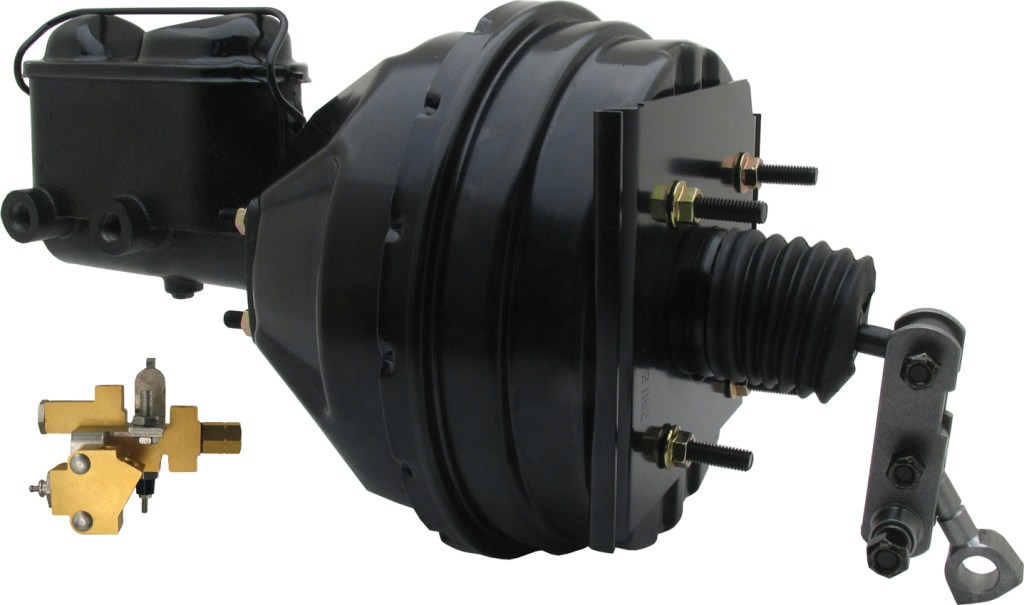
The first widespread answer was refined in its simplicity: vacuum assistance. Using engine manifold vacuum, a diaphragm inside a round metal canister multiplied the force applied by the driver’s foot. Suddenly, stopping a two-ton vehicle did not require a calf the size of a construction worker. A light press could generate full hydraulic pressure.
What had once been a physical task became an almost effortless motion.
Drivers did not notice the system working. That was the point.
Why It Never Went Away
Over time, brake boosters stopped being an enhancement and became an expectation. Modern safety regulations assume consistent, high deceleration with minimal driver effort. Automakers design for panic stops, not just normal ones. A braking system must perform identically whether the driver is 5-foot-2 or 6-foot-4, whether they are calm or terrified.
And as vehicles became even more complex, adding ABS, stability control, and automated emergency braking, the brake system stopped being purely mechanical. It became a managed system, actively controlled and constantly adjusted.
Even the source of vacuum changed. Turbocharged engines reduced manifold vacuum, forcing manufacturers to adopt electric pumps and electro-hydraulic or brake-by-wire systems. In electric vehicles, the old vacuum booster is gone entirely, replaced by software-controlled assist and electric actuation.
The “feel” of braking, once a direct mechanical conversation between foot and brake shoe, is now carefully engineered.
The Irony of Progress
It is easy to look back and presume early cars did not need brake boosters because they were somehow more efficient. In reality, they lived in a different era, one where speed, weight, and safety expectations were lower, and where human effort filled the gap that technology now covers.
Modern brake systems did not remove the need for strength.
They removed the requirement for it.
And in doing so, they made stopping a car less about force, and more about certainty.


Leave a Reply