Published by Christopher J. Holley | Mopar History & Tech | May 2026
Carter AFB on the 426 Hemi When the Rear Carb Ran the Show
There is a persistent assumption in Mopar circles that a dual quad Hemi simply runs two identical carburetors doing the same job. It is a clean idea and an easy one to repeat. It is also not how the factory Carter AFB system actually works on a 426 Street Hemi.
Reality is more structured and less symmetrical than most people expect.
The system is not two equal carburetors sharing identical responsibility. It is a divided fuel system with defined roles, and those roles are assigned based on control, not appearance.
WHAT AN AFB REALLY IS
The Carter AFB is a straightforward performance carburetor design. It uses mechanical secondaries and metering rods for fuel control. It was engineered primarily for single carburetor V8 engines with stable vacuum signal and predictable airflow demand.
On those engines it works in a very linear way. One carburetor sees one intake signal and responds accordingly. Idle, cruise, and wide-open throttle behavior are all interpreted through a consistent vacuum environment.
That is the world the AFB was designed for.
The 426 Hemi is not that world.
THE HEMI PROBLEM
The 426 Street Hemi does not provide a clean steady vacuum signal. It produces reversion pulses, low idle vacuum, and uneven airflow behavior at low engine speeds. The intake signal is unstable even when the engine is running correctly.
When Chrysler added dual Carter AFB carburetors, the problem was not simply airflow capacity. It was signal management across two carburetors that are both trying to interpret a turbulent intake environment.
The system had to be assigned roles so that one carburetor could stabilize low speed behavior while the other contributed without disrupting control.
FACTORY REALITY
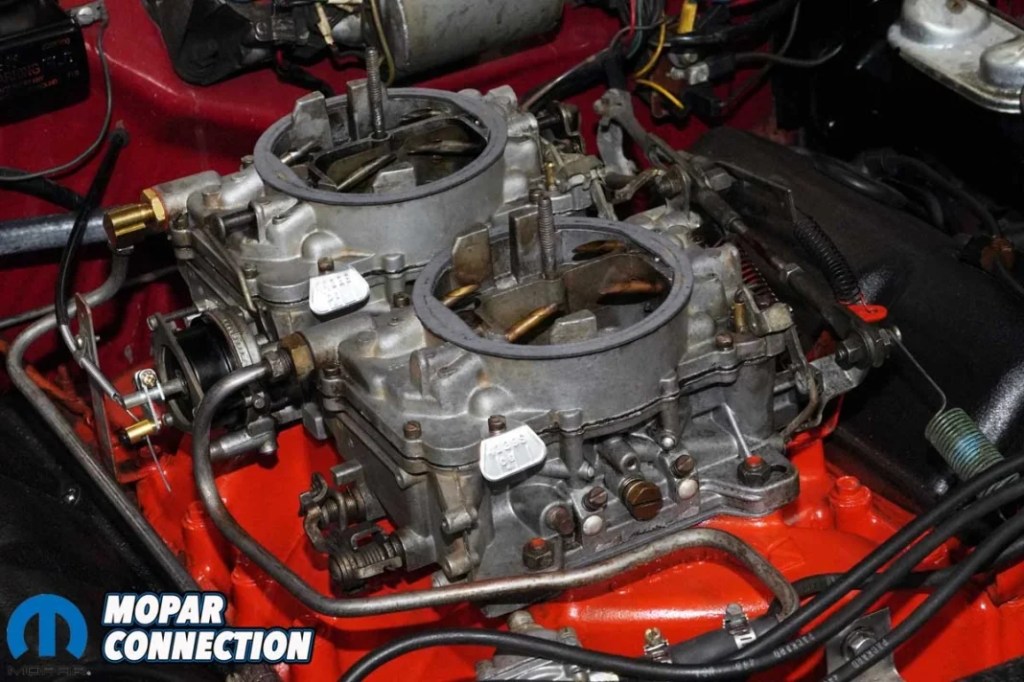
On factory 426 Street Hemi Carter AFB dual quad setups the rear carburetor is the control carburetor at idle and low speed operation.
The rear carburetor carries the choke system. It manages cold start enrichment. It controls fast idle behavior. It establishes the baseline idle and low throttle fuel delivery.
The front carburetor does not carry a choke in factory configuration. It does not control cold start enrichment. It does not set idle speed behavior.
This means the rear carburetor is the primary control point when the engine is cold or operating at low throttle.
WHAT THE FRONT CARBURETOR DOES
The front carburetor is mechanically linked into the system but does not take control authority at idle. It contributes airflow and fuel delivery as throttle demand increases, but it is not responsible for stabilizing the engine at low speed.
At part throttle both carburetors participate. At wide open throttle, both carburetors are fully active. But at idle and cold operation the system is anchored by the rear carburetor.
WHY CHRYSLER BUILT IT THIS WAY
The rear carburetor location allows more practical integration of choke hardware and throttle linkage control. It provides a stable reference point for idle airflow management. It also simplifies cold start calibration by concentrating enrichment and fast idle functions in one place.
The front carburetor is kept mechanically simpler. This reduces variables in airflow response as engine demand increases and allows the system to scale more cleanly under load.
The design is not about symmetry. It is about assigning stability to the carburetor that has the most direct control over engine behavior at low speed.
STANDARD AFB VERSUS HEMI AFB SYSTEM
A standard AFB is designed for a single engine signal. It interprets vacuum changes from one carburetor location and responds with predictable fuel delivery adjustments.
A Hemi dual AFB system is not interpreting a single signal. It is responding to a divided and unstable intake environment where airflow demand is split and constantly changing.
The rear carburetor stabilizes low speed operation. The front carburetor follows demand and contributes airflow as engine speed increases. Both carburetors are fully active at wide open throttle, but their roles are not identical at all operating points.
WHAT THIS MEANS IN PRACTICE
This is why properly set up Hemi dual AFB systems are sensitive at idle and low speed operation. The rear carburetor carries the responsibility for cold start quality and idle stability. If it is not correctly calibrated the entire system suffers.
As throttle increases the system becomes more balanced. At full throttle, both carburetors function as a unified airflow system. But the foundation of drivability is established by the rear carburetor alone.
BOTTOM LINE
The Carter AFB system on a 426 Street Hemi is not a mirrored dual carb setup. It is a staged control system where the rear carburetor carries choke, idle, and cold start authority, and the front carburetor acts as a supporting airflow unit until engine demand brings both into full participation.
It is not front carb leadership. It is rear carb control with front carb contribution that scales with load.
That structure is what allows the system to function on an engine that does not behave like a conventional V8 at low speed and does not need conventional carburetor logic to operate correctly.
 Mopower Garage
Leave a comment