Published by Christopher J. Holley | Mopar History & Tech | June 2026
Why Collector Length Matters More Than Most Racers Think
In the world of carburetors, camshafts, and compression ratios, exhaust tuning is often treated like an afterthought, something you bolt on, not something you engineer. Yet on a properly matched small block Mopar, the exhaust system is not just a pathway for spent gases. It is a timed pressure wave device that can make or break how the engine behaves from the hit to the stripe.
At the center of that system is a deceptively simple component, the header collector.
The Combination of a Classic 340 Built to Work
Consider a well-balanced performance package:
- Chrysler 340 small block
- Edelbrock RPM aluminum heads
- RPM Air Gap intake manifold
- 1 5/8 primaries stepping to 1 3/4 headers
- 3-inch collector
- Mopar Performance 557 camshaft
- 4.10 rear gear
- Torqueflite 904 automatic
- 5200 RPM stall converter
- Shift point at 6600 RPM
On paper, this is an engine with a strong midrange and a clear operating window between roughly 4800 and 6700 RPM. But what defines how hard it pulls through that band is not just airflow or cam timing, it is exhaust wave timing.
The Collector Is Not a Pipe, It Is a Timing Device
Every time an exhaust valve opens, a high-pressure pulse races down the header primary tube. When that pulse reaches a change in area, such as the end of the collector, it reflects back as a pressure wave.
Critically, that reflected wave is not random. It returns as a negative pressure wave, and that wave can either help the engine or do nothing at all depending on when it arrives.
This is where most explanations go wrong.
The goal is not to have the wave arrive before the intake opens in isolation. The real objective is to have it arrive during valve overlap, the brief period when the exhaust valve is still open and the intake valve is just beginning to open. That overlap window is where scavenging actually happens.
What the Negative Wave Really Does
When the reflected negative wave reaches the exhaust valve while it is still open, it drops pressure in the exhaust port, increases the pressure differential out of the cylinder, and helps evacuate leftover exhaust gases still hanging in the chamber. That is scavenging.
Only after that evacuation occurs does the intake side benefit. With cylinder pressure reduced and residual exhaust minimized, the incoming air fuel mixture can begin filling the cylinder more efficiently.
The wave does not directly suck in fresh charge in a vacuum-like sense. It prepares the cylinder so the intake system can do its job more effectively.
Why This 340 Responds So Strongly
The .557 Mopar Performance camshaft is a key player in this system. With significant overlap, it exposes the engine to a wider scavenging window than a milder cam would allow. That makes exhaust tuning not just relevant, but influential.
Pair that cam with Edelbrock RPM heads that respond well to midrange velocity, an Air Gap intake that favors strong signal strength, and a 5200 RPM converter that places the engine directly into its power band, and the exhaust system becomes a critical tuning lever rather than a passive component.
Collector Length Shifting the Power Curve Without Touching the Engine
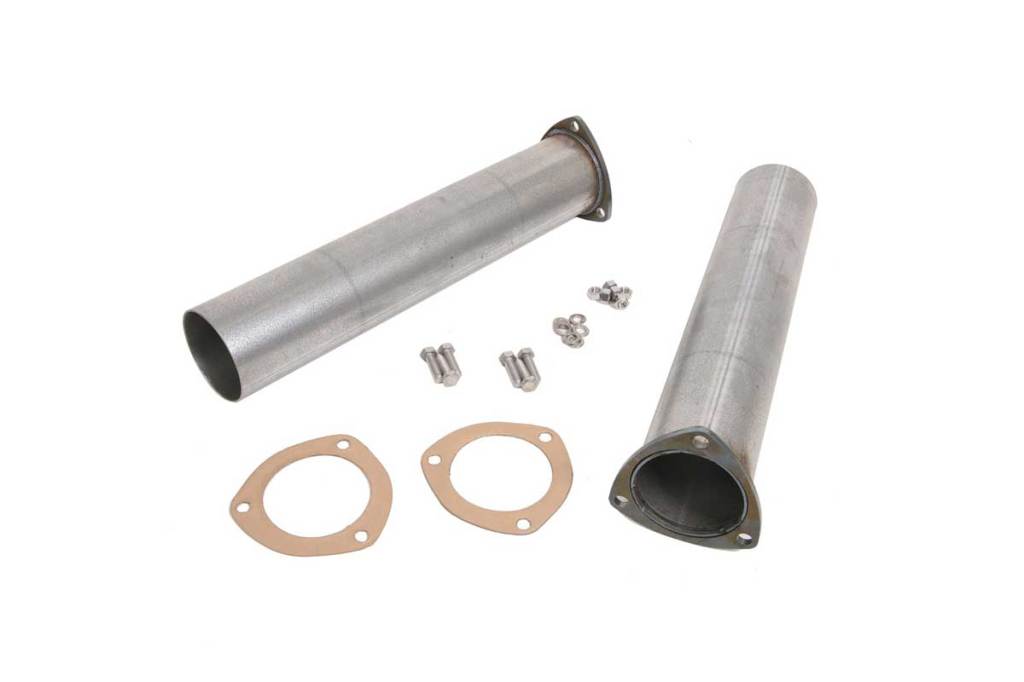
This is where collector length enters the equation. A collector is not simply a flow merge, it determines when the reflected wave returns to the cylinder.
Shorter collectors return the wave sooner, favoring higher RPM tuning.
Longer collectors delay the wave, shifting the scavenging effect lower in the RPM range.
On this combination, the engine is not a 7200 RPM piece. It lives and works between converter flash and a 6600 RPM shift point. That means the exhaust system must reinforce the midrange pull and the post shift recovery zone, not just peak horsepower.
What Works on This Combination
For a 340 in this configuration, the effective tuning window is surprisingly narrow. Too short, 8 to 12 inches, the wave returns too early, favoring RPM the engine never really uses. Too long, 24 plus inches, scavenging shifts too low, softening the pull through the upper midrange.
Just right, roughly 14 to 18 inches, aligns wave return with overlap at the RPM where the engine actually accelerates hardest. That middle range strengthens what matters most in a bracket style pass, 60-foot consistency, mid track acceleration, and clean recovery after the shift.
The Real Takeaway
Collector tuning is often misunderstood because it sits at the intersection of acoustics, gas dynamics, and valve timing. But on a properly matched engine, it behaves less like a bolt on part and more like a camshaft extension that only works through pressure waves instead of mechanical lift.
In this 340 combination, everything is already aligned, cam, heads, intake, gearing, and converter. The exhaust system is the final synchronization step. And at the center of that system is a simple truth.
The engine does not care about peak airflow numbers nearly as much as it cares about when the pressure wave returns during valve overlap. Get that timing right, and the engine feels like it picked up displacement without changing a single internal part.


Leave a Reply