
Published by Christopher J. Holley | Mopar History & Tech | July 2026
The Small Black Can That Keeps Fuel Vapors Out of the Atmosphere
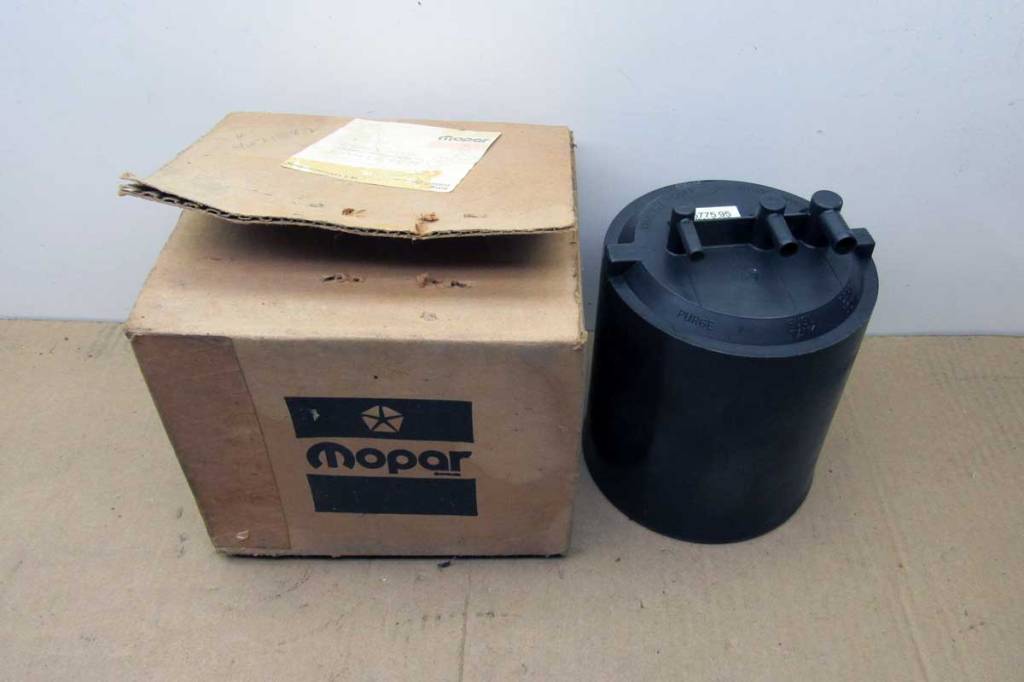
Open the hood of a 1975 Dodge, and you will find a black plastic canister mounted near the radiator support or inner fender. It is not particularly attractive, and most enthusiasts overlook it during a restoration. In fact, many of these canisters disappeared years ago when owners stripped away what they considered “unnecessary emissions equipment.”
That little canister, however, performs an important job. It does not rob horsepower, reduce performance, or make the engine run poorly. Instead, it captures gasoline vapors that would otherwise escape into the atmosphere and later feeds them into the engine to be burned. It is one of the simplest and most effective emissions devices Chrysler engineers ever developed.
Why the Canister Exists
Gasoline evaporates easily. Even when the engine is not running, fuel in the gas tank and carburetor constantly produces hydrocarbon vapors. Before evaporative emissions controls were introduced, these vapors simply vented into the atmosphere.
By the early 1970s, federal emissions standards required manufacturers to reduce these evaporative losses. Chrysler’s solution was elegantly simple: route the vapors into a charcoal-filled canister where they could be stored until the engine was running.
The charcoal acts like a sponge. It absorbs gasoline vapors while the vehicle is parked and releases them later when fresh air is drawn through the canister during engine operation.
Instead of wasting fuel, the engine burns it.
The Three Hose Connections
Most 1975 Dodge models equipped with Federal emissions have a charcoal canister with three primary hose connections.
Fuel Tank Vapor Line
One fitting connects directly to the fuel tank’s vapor line.
As the fuel warms during the day or after driving, pressure builds inside the tank. Rather than venting those vapors into the atmosphere, they travel through the vapor line to the charcoal canister.
The activated charcoal captures the hydrocarbons and stores them until the engine is running.
Without this connection, a garage would quickly fill with the familiar smell of gasoline after parking the vehicle.
Carburetor Bowl Vent
The second fitting connects to the carburetor float bowl.
Anyone who has shut off a hot engine has experienced heat soak. As engine temperature rises after shutdown, fuel inside the carburetor begins to boil and evaporate.
Prior to evaporative emissions controls, those vapors escaped directly through the carburetor vent.
Beginning in the mid-1970s, Chrysler routed the carburetor bowl vent to the charcoal canister instead. The vapors are trapped inside the activated charcoal rather than escaping into the air.
This system also reduces fuel odor after parking and helps minimize fuel loss during hot weather.
Purge Line
The third fitting is the purge connection.
Once the engine has warmed and is operating under the proper conditions, engine vacuum begins drawing air through the charcoal canister.
Fresh air enters the canister, passes through the activated charcoal, and carries the stored gasoline vapors into the intake manifold or carburetor, where they become part of the normal air-fuel mixture.
Nothing is wasted. The hydrocarbons stored while the vehicle was parked become usable fuel once the engine is running.
The purge system is calibrated so that vapors are introduced gradually. Dumping too much vapor into the engine at idle would upset the fuel mixture, so Chrysler engineered the system to purge primarily during light cruise and normal driving conditions.
What is Inside the Canister?
Although the outside appears to be nothing more than a plastic container, the inside is carefully designed.
The canister contains:
- Activated charcoal pellets or granules
- Internal passages that distribute airflow evenly
- Screens that keep charcoal particles from entering the hoses
- A fresh-air opening at the bottom
Activated charcoal has an enormous internal surface area. A surprisingly small amount can temporarily store a significant quantity of fuel vapor.
When purge air flows through the canister, the hydrocarbons are released from the charcoal and carried into the engine.
The charcoal itself is not consumed during normal operation and can remain effective for decades unless contaminated with liquid gasoline or damaged by moisture.
Typical Vapor Flow
Engine Off
Fuel in the tank expands as temperatures increase.
Fuel vapors travel from the fuel tank to the charcoal canister.
Heat from the engine causes gasoline inside the carburetor float bowl to evaporate.
Those vapors also enter the charcoal canister.
The activated charcoal stores both sources of hydrocarbons until the next time the engine runs.
Engine Running
As vacuum develops at the purge port, fresh air is drawn into the bottom of the canister.
The incoming air passes through the charcoal bed and carries the stored vapors into the intake.
The hydrocarbons mix with the incoming air and fuel and are burned during normal combustion.
The process continuously cleans and regenerates the charcoal for the next time the vehicle is parked.
Does the Canister Hurt Performance?
This question has circulated among enthusiasts for decades.
The answer is no.
The charcoal canister stores fuel that would otherwise be lost to evaporation. During normal operation, those vapors become part of the engine’s fuel supply.
Unlike exhaust gas recirculation or spark-retard strategies used during the emissions era, the charcoal canister does not reduce engine power. In fact, removing it simply allows usable gasoline to escape into the atmosphere.
For a stock or restored muscle car, retaining the canister offers the benefits of reduced fuel odor, improved garage air quality, and authentic factory appearance without sacrificing horsepower.
Common Problems
While the system is simple, several issues can develop after fifty years.
Cracked rubber hoses are the most common problem. Air leaks can prevent proper purge operation and allow fuel odors to escape.
Damaged or saturated charcoal canisters are less common but do occur, particularly if liquid gasoline enters the canister because of an overfilled fuel tank or malfunctioning fuel system.
Incorrect hose routing is another frequent issue after restoration work. Mixing up the purge, tank, and carburetor connections can create fuel odors, poor purge operation, or driveability complaints.
Fortunately, the system is easy to inspect once the hose routing is understood.
Restoration Tips
If you are restoring a 1975 Dodge, do not discard the charcoal canister simply because it looks like emissions clutter.
Clean the exterior with mild soap and water rather than harsh solvents that can damage the plastic housing.
Replace all rubber vapor hoses with ethanol-resistant vapor hose of the correct diameter.
Verify that each hose is connected to its proper fitting before the first startup.
If the canister has become fuel-soaked or physically damaged, consider sourcing a good original replacement or a quality reproduction that maintains the factory appearance.
The Bottom Line
The charcoal canister is one of those components that quietly does its job every time you drive your classic Dodge. It captures fuel vapors from both the gas tank and the carburetor, stores them safely inside activated charcoal, and returns them to the engine to be burned when conditions are right.
Its three primary hose connections each serve a specific purpose:
- Fuel Tank Vapor Line: Captures vapors expanding from the fuel tank.
- Carburetor Bowl Vent: Stores vapors generated in the carburetor after shutdown.
- Purge Line: Delivers the stored vapors back to the engine during normal driving.
Unlike many emissions devices introduced during the 1970s, the charcoal canister carries virtually no performance penalty. Instead, it reduces fuel odor, prevents gasoline loss, and helps preserve the originality of your restoration. Sometimes the most overlooked parts under the hood are also among the smartest engineering solutions Chrysler ever produced.


Leave a Reply