Published by Christopher J. Holley | Mopar History & Tech | July 2026
For many enthusiasts, the catalytic converter represents the moment the muscle car era truly ended. While insurance surcharges, rising fuel prices, and stricter emissions regulations had already begun to choke the horsepower wars, the arrival of the catalytic converter for the 1975 model year became the most visible symbol of a changing automotive landscape.
For decades, enthusiasts have blamed the catalytic converter for killing horsepower. The truth, however, is far more complicated.
The Air Was Getting Dirty
By the late 1960s, America’s cities were struggling with severe air pollution. Los Angeles had become famous for its thick smog, while other major metropolitan areas experienced similar problems. Scientists determined that much of the pollution came from automobile exhaust, which contained three primary pollutants:
- Hydrocarbons (HC) – unburned fuel
- Carbon monoxide (CO) – poisonous gas created by incomplete combustion
- Oxides of nitrogen (NOx) – formed during high combustion temperatures
Congress responded with the Clean Air Act of 1970, requiring manufacturers to dramatically reduce emissions over the coming years.
Automakers initially tried several approaches. Lower compression ratios, retarded ignition timing, exhaust gas recirculation (EGR), lean carburetor calibrations, air injection pumps, and evaporative emissions controls all helped reduce pollution. But these measures alone would not be enough to meet the increasingly strict federal standards.
A more sophisticated solution was needed.
Enter the Catalytic Converter
Beginning with most 1975 model year passenger cars sold in the United States, catalytic converters became standard equipment.
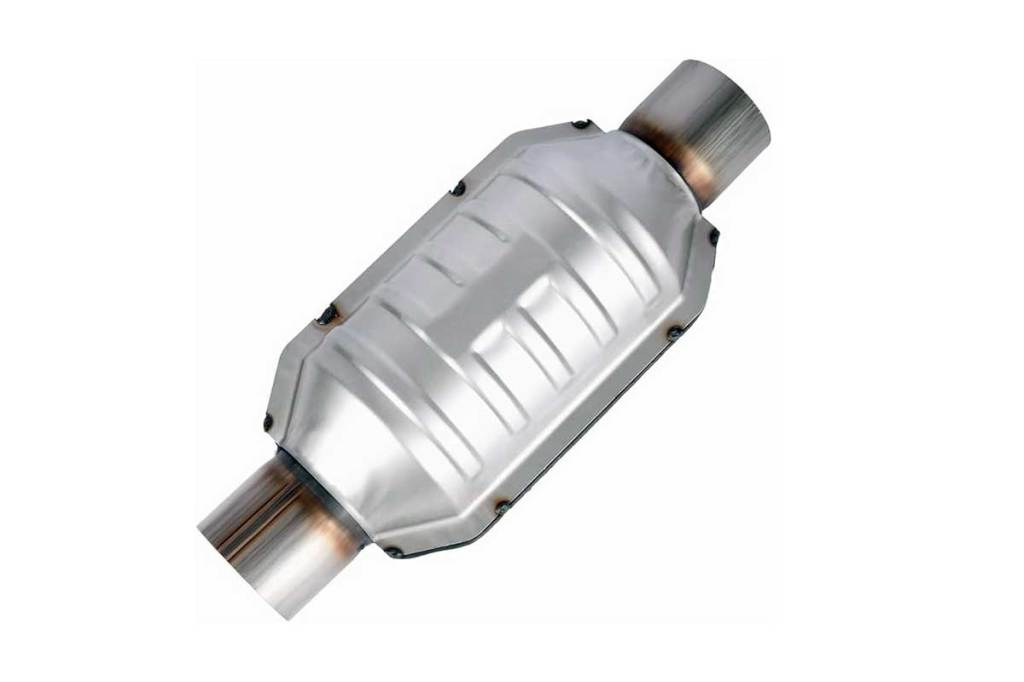
Unlike a muffler, which simply reduces exhaust noise, the catalytic converter is a chemical reactor. Inside the steel housing was a pellet (bee-bee) type converter (ceramic honeycomb came later) coated with precious metals including platinum, palladium, and eventually rhodium.
As hot exhaust gases pass through the honeycomb, these metals act as catalysts, promoting chemical reactions without being consumed themselves.
The converter changes harmful pollutants into far less harmful gases:
- Carbon monoxide becomes carbon dioxide.
- Unburned hydrocarbons become carbon dioxide and water vapor.
- Nitrogen oxides are reduced into harmless nitrogen and oxygen.
The result is dramatically cleaner exhaust emissions.
Why Leaded Gasoline Disappeared
One major problem quickly emerged.
The tetraethyl lead that had been used in gasoline for decades would coat the catalyst, permanently preventing it from doing its job. Even a relatively small amount of lead contamination could ruin a catalytic converter.
To protect the new emissions systems, automakers switched to unleaded gasoline.
The transition happened surprisingly quickly. Fuel pumps were redesigned with smaller filler nozzles so leaded gasoline could not easily be dispensed into vehicles equipped with catalytic converters. By the mid-1970s, nearly every new passenger car required unleaded fuel.
This single change marked the end of an era. High-octane leaded premium fuel had helped support the high-compression muscle cars of the 1960s. Without it, compression ratios remained low for years.
Early Converters Had Their Limitations
The first catalytic converters were known as oxidation converters. They were designed primarily to reduce hydrocarbons and carbon monoxide.
To help these reactions occur, manufacturers installed engine-driven air pumps, often called “smog pumps” by enthusiasts, which injected fresh oxygen into the exhaust stream ahead of the converter.
Although effective, these early systems could not adequately reduce oxides of nitrogen.
That problem was solved in the early 1980s with the introduction of the three-way catalytic converter.
The three-way converter could simultaneously reduce hydrocarbons, carbon monoxide, and nitrogen oxides, but only if the engine maintained an air-fuel ratio extremely close to the ideal stoichiometric mixture of 14.7:1.
This requirement helped drive the widespread adoption of electronic fuel injection and oxygen sensors.
Did Catalytic Converters Kill Horsepower?
Many enthusiasts still believe catalytic converters were responsible for the dramatic horsepower decline of the mid-1970s.
They certainly added some exhaust restriction, particularly the earliest pellet-style designs used by several manufacturers. However, they were only one small piece of a much larger story.
Horsepower had already fallen sharply before catalytic converters appeared.
Several factors contributed:
- Compression ratios dropped from over 10:1 to around 8:1.
- Camshafts became much smaller to improve idle quality and emissions.
- Ignition timing was heavily retarded.
- Carburetors were calibrated much leaner.
- Exhaust gas recirculation diluted the incoming air-fuel mixture.
- Manufacturers switched from gross horsepower ratings to the more realistic SAE net horsepower ratings beginning in 1972.
A 1970 engine rated at 375 gross horsepower might only produce around 300 net horsepower under the newer testing standard before any mechanical changes were made.
By the time catalytic converters arrived in 1975, much of the horsepower loss had already occurred.
Chrysler’s Experience
Chrysler’s high-performance era effectively ended after the 1971 model year. Compression ratios fell dramatically in 1972, and horsepower ratings dropped as the company shifted to SAE net measurements.
When catalytic converters became standard in 1975, Chrysler’s V8 lineup already looked very different from the legendary 340, 383, 426 Hemi, and 440 Six Barrel engines of only a few years earlier.
The new emission-controlled engines emphasized fuel economy, drivability, and compliance with federal regulations rather than quarter-mile performance.
For many Mopar enthusiasts, the catalytic converter became the visual reminder that the horsepower wars were over.
Modern Catalytic Converters Are Surprisingly Efficient
Today’s catalytic converters are vastly more efficient than their 1975 ancestors.
Advances in ceramic substrates, precious metal coatings, engine management systems, oxygen sensors, and electronic fuel injection allow modern converters to remove well over 95 percent of harmful emissions while creating very little exhaust restriction.
In fact, many late-model performance vehicles producing 700 horsepower or more retain factory catalytic converters with virtually no impact on street performance.
This demonstrates that converter technology itself is not the enemy of horsepower. Rather, proper engine calibration and improved converter design have largely eliminated the compromises that characterized the early years of emissions control.
The Legacy of the Catalytic Converter
The catalytic converter arrived during one of the most difficult transitions in automotive history. To enthusiasts, it represented shrinking horsepower ratings, disappearing high-compression engines, and the end of the golden age of muscle cars.
Yet its impact on air quality has been remarkable.
Modern vehicles produce only a tiny fraction of the emissions generated by similar vehicles built before the mid-1970s, even while delivering better fuel economy, greater reliability, and far more horsepower.
The catalytic converter did not single-handedly kill the muscle car. Instead, it became the most recognizable symbol of an industry adapting to new environmental expectations. While enthusiasts understandably mourned the loss of the tire-shredding monsters of the late 1960s, today’s performance cars prove that clean emissions and impressive horsepower no longer have to be mutually exclusive.
For restorers and collectors, catalytic converters mark a clear dividing line in automotive history. Cars built before 1975 represent the final chapter of the original muscle car era, while those that followed entered a new age where engineering ingenuity would eventually reclaim the performance that emissions regulations initially seemed to take away.


Leave a Reply