
Published by Christopher J. Holley | Mopar History & Tech | August 2026
How Detroit Found the Sweet Spot Between Horsepower, Octane and Reliability
During the muscle car era, there was a number that seemed to appear everywhere on Detroit’s hottest engines: 10:1. It was not exactly 10.0:1 every time. Some engines were at 9.5:1, others at 10.25:1 or 10.5:1. The 426 Hemi was rated at 10.25:1, while many high-performance big blocks hovered right around the same territory.
But there was a reason so many performance engines of the 1960s ended up in that neighborhood.
Ten-to-one was the sweet spot.
It offered a meaningful increase in thermal efficiency and power without pushing a street engine beyond the practical limits of the gasoline, combustion chambers, ignition systems, and operating conditions of the day. And understanding why Detroit settled there tells us a lot about how muscle-car engines were actually engineered.
Compression: Cheap Horsepower
Increasing compression ratio is one of the simplest ways to extract more power from an internal-combustion engine.
When the compression ratio is increased, the air-fuel mixture is compressed into a smaller volume before ignition. That increases the thermal efficiency of the engine and allows more of the fuel’s energy to be converted into useful work.
In simple terms, more compression can mean more power from the same displacement and the same amount of fuel. That made compression particularly attractive to Detroit engineers.
Adding cubic inches cost money. A larger carburetor cost money. More elaborate induction systems cost money. But increasing compression could provide a substantial performance benefit with relatively few additional components.
During the 1950s and 1960s, compression ratios steadily climbed as manufacturers became better at designing combustion chambers and as gasoline technology improved. But there was a limit.
The Enemy Was Detonation
That limit was detonation as compression increases, cylinder pressure and temperature increase. Under certain conditions, the unburned portion of the air-fuel mixture can spontaneously ignite rather than waiting for the flame front produced by the spark plug.
The result is the familiar metallic knock associated with detonation. And Detroit could not design engines in a vacuum. The engine had to operate on the gasoline available to the customer.
During the muscle-car era, high-octane leaded premium gasoline made relatively high compression ratios possible. Lead compounds were extremely effective at increasing octane and suppressing knock. But even with excellent gasoline, there was only so far engineers could go.
A compression ratio of 12:1 might look attractive on paper. Still, a production automobile had to operate on a hot summer afternoon, sitting in traffic, with the air conditioning running, the engine slightly out of tune and perhaps a little carbon accumulated in the combustion chambers. The engineer had to build an engine that survived real life, not a dyno cell.
Ten-to-One Was a Compromise
This is where the approximately 10:1 compression ratio became so attractive. It was high enough to provide a significant efficiency and power advantage, but not so high that detonation became an unavoidable problem under normal operating conditions.
That compromise was particularly important for muscle cars. These were not race cars.
A 426 Hemi, 440 Six Pack or 383 Magnum had to start on a cold morning, idle in traffic, tolerate an automatic transmission, operate with air conditioning and survive thousands of miles of street driving.
The customer wanted horsepower. The manufacturer also wanted the engine to come back under warranty as rarely as possible. Ten-to-one, or somewhere close to it, was a very good place to be.
Static Compression Did Not Tell the Whole Story
There is another reason the numbers can be misleading. The compression ratio stamped in the specifications was the static compression ratio. But the engine’s actual operating compression is influenced heavily by the camshaft.
A performance camshaft holds the intake valve open longer. That means that after the piston begins moving upward on the compression stroke, some of the mixture can still escape through the intake valve.
The result is a lower effective, or dynamic, compression ratio. This allowed engineers to use relatively high static compression ratios in performance engines without necessarily producing an engine that was constantly detonating.
It is one reason a 10.5:1 engine with a long-duration performance cam does not behave like a 10.5:1 engine with a mild stock camshaft. The number on the specification sheet was only part of the story.
Better Combustion Chambers Made More Compression Possible
Detroit was also getting better at making the combustion process more efficient. Combustion-chamber shape, spark-plug location, mixture motion and quench area all influence how quickly and evenly the mixture burns.
A well-designed chamber can reduce hot spots and improve flame travel, allowing engineers to extract more power without simply continuing to raise compression. Chrysler was particularly aggressive in this area.
The company’s wedge engines and, eventually, the hemispherical 426 Hemi demonstrated how much power could be produced when combustion-chamber design, compression, cylinder-head flow and induction were developed together.
And notice something interesting about those engines. The 426 Hemi was rated at 10.25:1. The 440 Six Pack was roughly 10.3:1, depending upon application and model year. These engines were producing enormous power, yet Chrysler did not need to push them to 11.5:1 or 12:1 compression ratios. The engineers had found other ways to make horsepower.
More Compression Was Not Always More Power
This is an important point that gets lost when we look at old muscle-car specifications today. It is tempting to assume that if 10:1 is good, then 11:1 must be better, and 12:1 must be better still.
Not necessarily. Once an engine reaches the point where the available fuel cannot tolerate the cylinder pressure, additional compression can actually become a liability.
The engineer may have to reduce ignition timing to prevent detonation. That can erase some of the theoretical power advantage of the higher compression ratio. In other words, the best compression ratio is not necessarily the highest compression ratio.
It is the highest ratio that works with the entire combination.
Fuel.
Camshaft.
Combustion chamber.
Ignition timing.
Engine temperature.
Cylinder pressure.
And intended use.
Then the Rules Changed
By the early 1970s, the world that had allowed Detroit to build 10:1-plus performance engines was beginning to disappear. Emissions regulations were becoming increasingly restrictive. Fuel formulations were changing. Unleaded gasoline was coming. Octane availability changed. And manufacturers were forced to modify engines to meet new emissions requirements.
Compression ratios began falling. The change is obvious when you compare a typical high-performance engine from the late 1960s with one from the middle of the 1970s. The cubic inches might still be there. The engine might still carry a big four-barrel carburetor. The exhaust system might still have dual pipes.
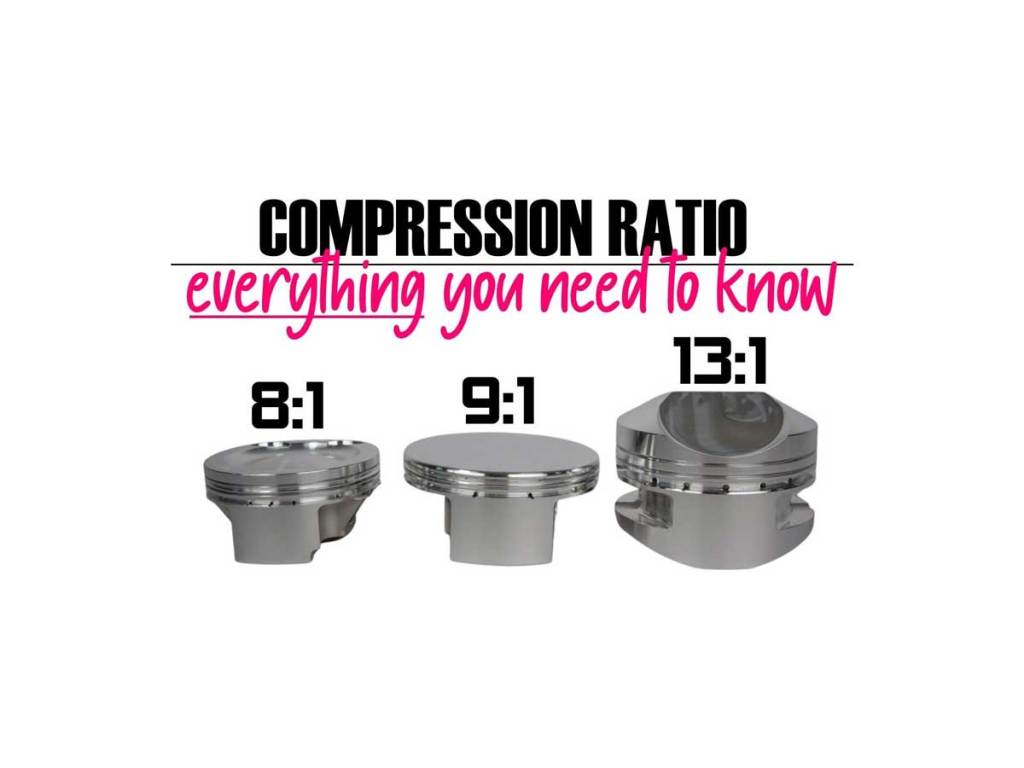
But compression was falling toward the 8:1–9:1 range, and horsepower fell with it. The muscle-car era was rapidly becoming something different.
The Number Was Never Really About “10”
The fascinating thing is that 10:1 was not a magic number. Detroit did not discover that exactly 10.00:1 was the perfect compression ratio. Instead, engineers discovered a region where several competing factors came together. They wanted enough compression to improve efficiency and power.
They needed enough octane margin to prevent detonation. They needed the engine to survive real-world temperatures and loads. They had to accommodate the camshaft and combustion-chamber design. And they had to build an engine that could be driven every day.
The result was a remarkable period in automotive history when high-octane gasoline, improving combustion technology, and relatively few emissions restrictions allowed manufacturers to push street-engine compression to levels that would soon disappear.
Around 10:1 was the compromise that worked.
It was not the highest compression Detroit could build. It was the compression ratio that allowed Detroit to build engines that were powerful enough to make headlines, and durable enough to let their owners drive them home.


Leave a Reply