
Published by Christopher J. Holley | Mopar History & Tech | August 2026
When rebuilding an engine, valve guides rarely receive the attention given to pistons, bearings, crankshafts, and cylinder heads. Yet the valve guide is one of the most important precision surfaces in the cylinder head. It controls the valve’s movement, maintains its alignment with the seat, and helps determine how well the valve can transfer heat into the head.
That makes the condition of the guide bore critical.
A valve guide does not have to be replaced simply because it is dirty, carboned, or contains deposits. Before measuring or installing a valve, the guide should be properly cleaned. And while a piece of solvent-soaked cloth may seem sufficient, it often is not. Proper guide cleaning calls for tools specifically designed to get inside the bore without damaging the guide.
More Than Just Removing Carbon
Valve guides accumulate a variety of contaminants during an engine’s service life. Carbon, varnish, oil residue, combustion byproducts, and even small amounts of corrosion can build up inside the guide. On a recently disassembled engine, the guide may also contain abrasive material left behind from normal wear.
The problem is that these deposits can affect measurements.
If a valve stem is measured accurately but the guide contains deposits, an inside-diameter measurement of the guide may not represent the actual condition of the bore. Likewise, trying to install a clean valve into a dirty guide can push debris farther into the guide or create a false indication of tightness.
Cleaning is not therefore just a cosmetic operation. It is part of the inspection process.
Guide Brushes: The First Line of Defense
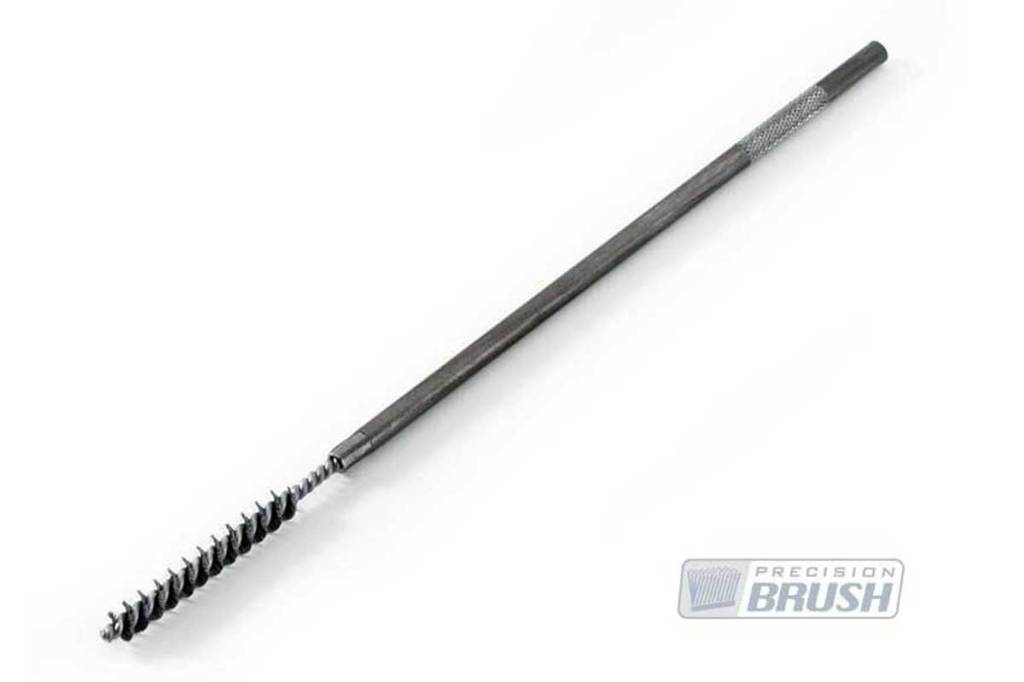
One of the simplest tools for cleaning valve guides is a guide-cleaning brush. These brushes generally consist of a small-diameter wire brush mounted on a handle or flexible shaft.
The important consideration is diameter.
A brush should be appropriately sized for the guide being cleaned. It should contact the bore enough to remove deposits but should not require excessive force to pass through it. Brass brushes are particularly useful when you want effective cleaning with less risk of aggressively cutting into the guide material.
Steel brushes are also available, but they should be selected and used with care. The objective is to remove contamination; not machine the guide.
For routine cleaning, a properly sized brush combined with solvent can remove surprisingly stubborn deposits.
The Valve Guide Hone
When the guide requires more than simple brushing, a small honing tool can be useful. Guide hones are designed to clean and lightly finish the inside of a guide while maintaining the existing bore.
This is particularly valuable when working with guides that have developed varnish or deposits that a brush cannot completely remove.
The distinction between cleaning and sizing is important, however.
A honing operation removes material. Therefore, it should never be treated as an automatic part of guide servicing. If the guide is already at its service limit, unnecessary honing can make a marginal guide unusable.
The proper sequence is simple: clean first, measure second, remove material only when the specifications and repair procedure call for it.
Reamers Have a Different Job
Valve-guide reamers are often confused with cleaning tools, but their purpose is considerably more aggressive.
A reamer is used to establish or restore a specific guide diameter. It removes material from the guide and can be used when installing replacement guides, correcting guide dimensions, or preparing a guide for a particular valve stem.
That means a reamer should not be used simply because the guide is dirty.
Using a reamer as a cleaning tool is essentially machining the guide without first determining whether machining is necessary. In a precision engine, that is the wrong approach.
The reamer belongs later in the process; after inspection has established that material needs to be removed.
Flexible Guide Brushes
For heads with difficult access, flexible-shaft brushes are particularly convenient. Instead of trying to maneuver a rigid brush through the cylinder head, the flexible shaft allows the brush to follow the guide while the operator controls it from outside the port.
These are especially useful when servicing heads that remain assembled to some degree or when access to the guide is restricted by the casting.
A drill can sometimes be used with a suitable brush, but caution is warranted. High rotational speed is not necessary to clean a valve guide. Excessive speed can generate heat, damage the brush, or turn a simple cleaning operation into an uncontrolled abrasive process.
Slow speed and solvent are usually the better combination.
Do not Forget the Valve Stem
Cleaning the guide is only half the job.
The valve stem itself should be thoroughly cleaned before it is used to check the guide. Carbon and varnish on the stem can produce misleading results when checking fit. More importantly, inserting a dirty stem into a freshly cleaned guide simply transfers the contamination back into the bore.
A clean guide and a clean valve stem provide the starting point for meaningful inspection.
Once both are clean, the guide can be measured with the appropriate tooling, such as a small-bore gauge or dedicated valve-guide measuring equipment.
Cleaning Tools Protect Expensive Parts
The temptation in engine rebuilding is to think of small cleaning tools as optional accessories. They are not.
A properly sized guide brush costs very little compared with a cylinder head. A good guide-cleaning setup can be used repeatedly and can prevent an inexpensive deposit from becoming a bad measurement, premature valve wear, or an unnecessary machining operation.
The larger lesson is that precision engine work begins before the measuring instruments come out.
You cannot accurately measure a dirty part.
Valve guides are small, but they are precision components. Give them the same attention you give the crankshaft journals, bearing surfaces, and cylinder bores. Clean them properly, measure them accurately, and only remove material when the specifications tell you to.
That approach does not just make the engine cleaner.
It makes the rebuild more accurate.


Leave a comment