Published by Christopher J. Holley | Mopar History & Tech | August 2026
For most of his legendary Pro Stock career, Bob Glidden was a Ford man. The Pintos, Mustangs and, most famously, the 1978 Ford Fairmont had made him one of the most feared drivers in NHRA competition. By the end of 1978, Glidden and Ford were nearly synonymous with Pro Stock dominance. Then, almost overnight, Glidden became a Mopar driver.
The story really begins with the 1978 season. After winning back-to-back championships in 1974 and 1975, Glidden had finished second to Don Nicholson in 1977. In 1978, he came back with a vengeance, winning seven NHRA national events and setting a new single-season record for Pro Stock victories.
The new Ford Fairmont was particularly impressive. Introduced midway through the season, it went undefeated at national events for the remainder of the year. Glidden also qualified No. 1 at 23 consecutive races, a remarkable demonstration of just how far ahead his operation had become.
But success did not necessarily guarantee a future with Ford. Glidden was looking for more financial support for 1979, and Ford was not willing to provide what he wanted. Chrysler saw an opportunity and stepped in.
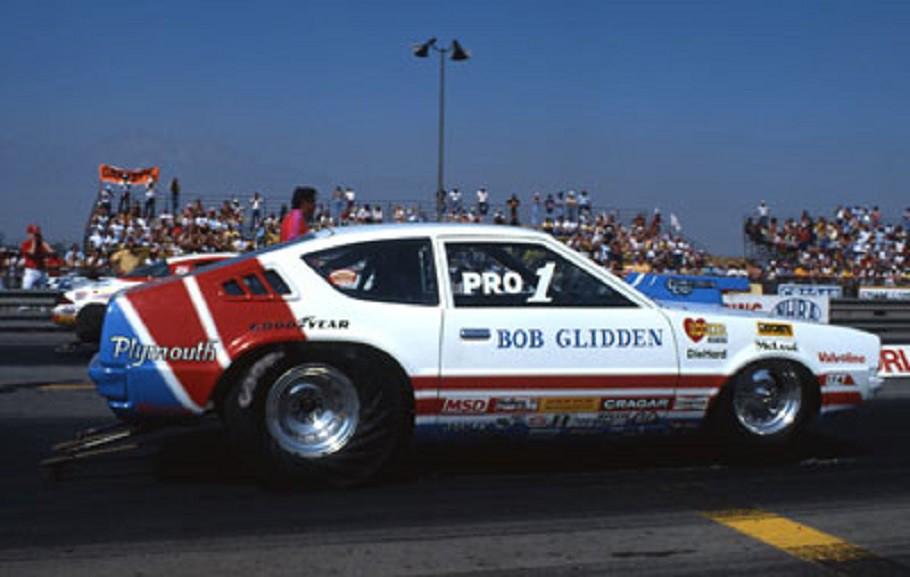
“Chrysler came along and offered me, it was not much money, but it was a lot more than nothing, plus all of the parts I needed,” Glidden later recalled. “So we raced the Plymouth for one year.” That Plymouth was an Arrow.
At first glance, the little compact Plymouth seemed an unlikely replacement for the dominant Fairmont. Underneath the fiberglass, however, was a serious Pro Stock combination. Glidden’s Arrow used a Chrysler small block based on the 340 architecture and fitted with W2 cylinder heads. Chrysler supplied the basic support and components, while Glidden and his team did what they had always done, developing the combination relentlessly.
And they did not need much time to figure it out. Glidden debuted the Plymouth Arrow at the 1979 Winternationals and won. He followed that victory with wins at the Gatornationals, Cajun Nationals and Springnationals.
The Arrow was not simply competitive. It was dominant. Glidden had finished 1978 by winning the final five national events of the season with the Fairmont. He opened 1979 by winning the first four national events with the Arrow. Put the two cars together, and Glidden had won nine consecutive NHRA national events.
The winning streak was even more impressive when divisional races were included. Glidden went 50 consecutive elimination rounds without losing.
That streak finally ended at the 1979 Mile-High Nationals at Bandimere Speedway. And remarkably, Glidden was not beaten on the racetrack. He red-lighted in the second round, ending one of the most incredible streaks in Pro Stock history.
The loss, however, did little to slow the Arrow down. Glidden finished the 1979 season with seven NHRA national-event victories, matching his total from the previous year, and captured his fourth Pro Stock championship. He also went undefeated in divisional competition.
For Plymouth, the season was even more significant. The marque had not been a major factor in Pro Stock for years. Butch Leal had given Plymouth a national-event victory with a Duster in 1973, and then the wins largely disappeared. Glidden changed that in a hurry. His Arrow accounted for seven national-event victories in 1979 and became one of the most successful Plymouth Pro Stock cars of its era.
What made the season particularly remarkable was what it said about Glidden. He was not simply a Ford driver who happened to be sitting in a Plymouth. He had taken an entirely different combination and immediately turned it into the dominant car in Pro Stock.
That was Glidden’s real talent. He understood the details. He tested constantly. He knew how to make horsepower, how to make a car leave, and, perhaps most importantly, how to turn a fast race car into a winning race car.
The Chrysler deal was supposed to continue. Glidden had a three-year agreement, and a Plymouth Volare was being prepared for the 1980 season. But Chrysler’s financial problems changed the plan. As the company struggled financially and eventually entered bankruptcy proceedings, its racing program was cut and Glidden’s contract was terminated.
Glidden returned to Ford in 1980 and continued his march toward becoming one of the most successful drivers in NHRA history. He would eventually collect 10 Pro Stock championships and 85 national-event victories.
But 1979 remains different. It was the year Bob Glidden, the ultimate Ford Pro Stocker, climbed into a Plymouth Arrow and proceeded to beat almost everybody he lined up against.
For one season, the Mad Dog was a Mopar man. And he was not just along for the ride. He won with it.


Leave a Reply