
Published by Christopher J. Holley | Mopar History & Tech | September 2026
When an electrical problem shows up in a vehicle, the first instinct is often to grab a voltmeter and check voltage. If the meter shows 12 volts, or 14 volts with the engine running, the assumption is that the electrical system must be healthy.
That assumption can be wrong.
A circuit can have plenty of available voltage and still fail to deliver the current a component needs. The culprit is often voltage drop, one of the most useful and frequently misunderstood concepts in automotive electrical diagnosis.
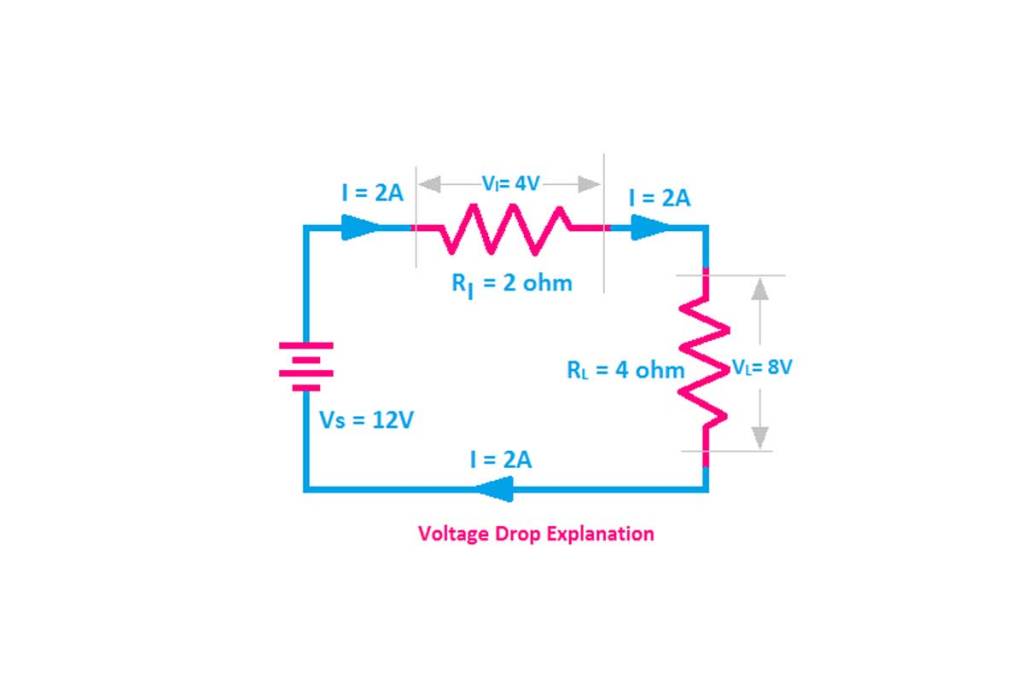
Voltage drop is simply the amount of electrical pressure that is lost as current travels through resistance in a circuit. Some voltage drop is normal. Every wire, connection, switch, fuse, relay, and ground has some resistance. The problem occurs when that resistance becomes excessive.
Think of electricity much like water flowing through a hose. If the hose is large and unrestricted, water flows easily. If the hose is pinched, clogged, or too small, pressure is lost across the restriction. The same basic thing happens in an electrical circuit. The important point is that voltage drop only becomes significant when current is flowing.
Suppose a battery measures 12.6 volts with the engine off. You connect a starter motor, but the starter barely turns. A voltage check at the battery may still show a reasonable number. Even checking voltage at the starter with the circuit unloaded may reveal nothing unusual. The problem might be a poor battery cable connection, corroded cable, damaged terminal, or weak ground.
When the starter attempts to draw hundreds of amps, that unwanted resistance becomes significant. The electrical pressure available at the starter falls, and the starter cannot produce the torque necessary to crank the engine properly.
This is why voltage drop testing is so valuable. It tests the circuit while the circuit is doing its job.
Ohms law gives us the relationship:
E = I × R
Voltage, represented by E, equals current, represented by I, multiplied by resistance, represented by R.
Consider a circuit with only 0.05 ohm of unwanted resistance. That does not sound like much. But if a starter is drawing 200 amps:
200 × 0.05 = 10 volts
Ten volts would be lost across that resistance.
A battery producing 12 volts cannot deliver 12 volts to the starter if 10 volts is being consumed by resistance somewhere in the circuit. The starter would see only about 2 volts.
This illustrates why a resistance that seems insignificant on a resistance meter can become a major problem when high current is involved.
Where Does Voltage Drop Occur? Voltage drop can occur anywhere in the circuit.
On the positive side, it can be caused by:
• Corroded battery terminals
• Loose connections
• Damaged battery cables
• Undersized wiring
• Poor crimp connections
• Faulty switches or relays
• Corrosion inside a cable
The ground side is just as important. A poor engine ground, corroded ground strap, loose ground connection, or damaged ground cable can create enough resistance to cause serious problems.
In fact, technicians sometimes spend considerable time replacing sensors, starters, alternators, or other components when the real problem is nothing more than a poor ground.
A voltage drop test is remarkably simple. Set a digital multimeter to DC volts. Instead of measuring voltage at a component by itself, place the meter leads across the portion of the circuit you want to test.
For example, to test the positive side of a starter circuit, place one meter lead on the positive battery terminal and the other on the starter positive terminal. Then operate the starter. The meter is measuring the voltage being lost between those two points.
The same principle applies to the ground side. Place one lead on the starter housing and the other on the negative battery terminal while cranking the engine. The meter now shows the voltage being lost through the ground circuit. This is fundamentally different from simply measuring battery voltage or checking the resistance of a cable with the circuit turned off.
A common diagnostic mistake is checking resistance with an ohmmeter and finding what appears to be a good circuit. A cable might measure almost zero ohms when there is no current flowing through it. But that does not necessarily mean it can carry several hundred amps without a significant voltage loss. The resistance may be extremely small, but the current can be extremely large.
That is why voltage drop testing is particularly useful for high current circuits such as starters, alternators, electric fans, fuel pumps, and winches. Rather than asking, “Does this wire have continuity?” voltage drop testing asks the much more important question:
Can this circuit deliver the electrical power the component needs while it is operating?
Imagine a starter circuit with a battery producing 12.5 volts. During cranking, the starter requires substantial current. A voltage drop test finds 0.8 volts lost on the positive cable and connections and another 0.7 volts lost through the ground circuit. That is a total circuit voltage drop of 1.5 volts.
The starter is therefore receiving approximately 11 volts rather than the 12.5 volts available at the battery, assuming those measurements were made under the same operating conditions. The starter may still work, but it is being forced to operate with less voltage than it should have. If the engine has high compression, cold oil, tight clearances, or a marginal battery, that lost voltage can be enough to turn a normal starting problem into a no start situation.
It is important to understand that some voltage drop is normal. Every electrical conductor and connection has resistance. The goal is not necessarily to achieve zero voltage drop. The goal is to keep voltage loss within an acceptable range for the particular circuit.
A small sensor circuit carrying very little current may tolerate only a small voltage loss before the voltage reaching the sensor becomes inaccurate. A high current starter circuit, meanwhile, can experience a larger absolute voltage drop and still function properly, depending on the circuit and manufacturer specifications. The correct specification should always come from the vehicle manufacturer or component manufacturer when available.
Voltage drop testing is one of the simplest ways to find electrical problems that are not obvious with a conventional voltage or continuity test.
A battery can test good.
A cable can show continuity.
A connection can look perfectly clean.
And yet the component can still fail to receive the voltage it needs.
The difference is what happens when current actually flows.
Voltage drop testing puts the electrical system under load and reveals resistance that otherwise remains hidden. For anyone diagnosing an automotive electrical problem, it is a valuable reminder that having voltage available at the battery is not enough.
The real question is whether that voltage can make it to the component when the component needs it. That is voltage drop.


Leave a Reply