
Published by Christopher J. Holley | Mopar History & Tech | September 2026
For generations of automobile owners, the ammeter was one of the few instruments that offered a direct look into what was happening inside the electrical system. Before scan tools, digital displays, and sophisticated battery-management systems, the ammeter gave the driver a simple answer to an important question: Was electrical current flowing into the battery or out of it?
On older vehicles, the answer was displayed by a needle that moved across a gauge marked DISCHARGE on one side and CHARGE on the other. When the engine was running and the charging system was supplying more current than the vehicle was using, the needle moved toward CHARGE. If electrical loads exceeded alternator or generator output, the needle moved toward DISCHARGE.
It was simple, understandable, and useful. It also meant that a substantial amount of electrical current had to pass through the instrument and its associated wiring. That eventually became a problem.
The story of the automotive ammeter is really the story of how engineers learned that measuring electrical current directly was not always the best way to monitor an increasingly sophisticated charging system.
The Original Ammeter
The early automotive electrical system was relatively simple. A generator produced electrical power, a voltage regulator controlled the charging system, and the battery stored energy for starting and operating electrical accessories when the generator could not provide enough current.
The ammeter was installed in series with the charging circuit so that current flowing to or from the battery passed through the gauge. The gauge could therefore show the direction and approximate magnitude of battery current. This arrangement made sense.
Consider a vehicle equipped with a 40-amp generator. If the electrical loads required 15 amps while the generator was producing 30 amps, approximately 15 amps would flow toward the battery. The ammeter would indicate a charge.
If the headlights, heater blower, windshield wipers, and other accessories were consuming 40 amps while the generator was producing only 30 amps, approximately 10 amps would have to come from the battery. The ammeter would indicate a discharge.
The gauge was not really telling the driver how much the generator was producing. It was telling the driver what was happening to battery current. That distinction is important.
With the engine running, a slight charge indication generally meant the charging system was keeping up with the electrical demand and supplying enough additional current to maintain the battery. A discharge indication meant the battery was supplementing the charging system.
The ammeter therefore became an early warning system. A driver who understood the gauge could sometimes recognize a charging-system problem long before the battery went dead. But there was a price for putting an ammeter in series with the battery circuit.
When Current Has to Pass Through the Dash
An ammeter capable of displaying substantial charging and discharging currents requires wiring capable of carrying those currents. The electrical path from the battery, through the charging system and vehicle wiring, to the ammeter and back again could carry considerable current.
Every connection, terminal, splice, and length of wire in that circuit became part of the high-current path. That created two concerns: voltage drop and heat.
Electrical resistance is normally undesirable in a high-current circuit. Even an exceedingly small resistance can produce measurable voltage drop and heat when substantial current flows through it.
The relationship can be expressed by Ohm’s law:
E = I × R
If 40 amps flows through a connection having only 0.01 ohm of resistance, the voltage drop across that connection is 0.4 volt. The power converted into heat is:
P = I² × R
At 40 amps, that same 0.01-ohm resistance produces 16 watts of heat.
The resistance may be tiny, but the current makes the consequences significant.
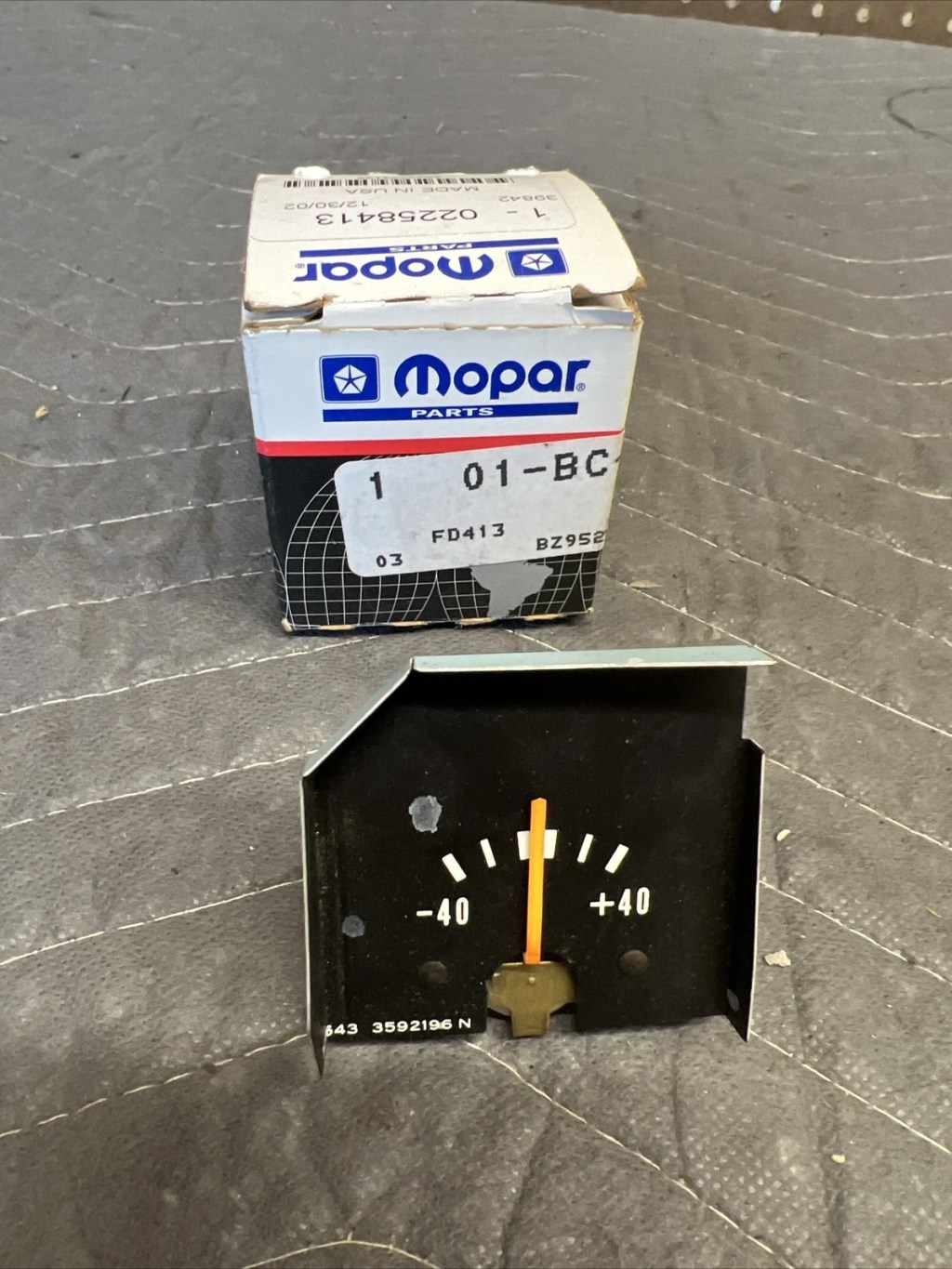
As automotive electrical systems became more powerful, engineers began looking for a better way to measure battery current without forcing all of that current through the instrument panel. The answer was the shunted ammeter.
Enter the Shunt
A shunted ammeter still measures current, but it does not require the entire charging-system current to pass through the gauge.
Instead, most of the current flows through a low-resistance section of the main circuit called a shunt. The ammeter is connected across that shunt and measures the exceedingly small voltage difference created by current flowing through it. This is an important change in philosophy.
The original ammeter effectively measured current by putting the gauge in the current path. The shunted ammeter measured current indirectly by measuring the voltage produced across a known resistance.
The shunt is intentionally designed to have an extremely low and predictable resistance. When current flows through it, Ohm’s law tells us that a small voltage will appear across the shunt. The gauge measures that small voltage and converts it into a current indication.
For example, imagine a shunt with a resistance of 0.001 ohm. At 40 amps, the voltage across the shunt would be:
E = I × R
E = 40 × 0.001
E = 0.04 volt
The gauge does not need to manage 40 amps. It only needs to respond to the small voltage generated across the shunt. That dramatically changes the requirements for the instrument-panel wiring.
Instead of routing the entire charging current through the gauge, engineers could keep the high-current path concentrated in the appropriate wiring and use smaller wires to connect the gauge to the shunt. The driver still sees an ammeter. The electrical system, however, is doing something quite different behind the dashboard.
Chrysler and the Shunted Ammeter
This change is particularly interesting when looking at Chrysler products. Older Chrysler vehicles commonly used a full-current ammeter arrangement. The charging-system current traveled through the bulkhead and instrument-panel circuitry associated with the ammeter.
As alternator output increased and vehicle electrical loads became greater, the high-current electrical path through the vehicle became increasingly important from a reliability standpoint. Chrysler eventually adopted a shunted arrangement on many vehicles.
The gauge could still display CHARGE and DISCHARGE, so from the driver’s seat the system looked familiar. Underneath the dashboard, however, the electrical architecture had changed.
The ammeter was no longer simply sitting in the path of all charging current. Instead, the charging current was measured indirectly through the shunt.
This illustrates something that is often missed when looking at an old automobile’s wiring diagram: the gauge on the dashboard may look identical while the electrical system behind it has changed substantially. The driver sees a needle. The engineer sees a measurement system.
Why Not Keep the Ammeter?
The shunted ammeter solved one problem, but it did not eliminate every reason for changing the way charging-system information was displayed. An ammeter tells us about current flow.
That is useful, but current flow is not necessarily the most important thing to know about the electrical system. The battery’s state of charge and the system’s ability to maintain the proper operating voltage became increasingly important as automobiles gained more electrical equipment.
Electronic ignition systems, fuel injection, computers, emissions controls, electric cooling fans, anti-lock brakes, air conditioning, entertainment systems, and other accessories all placed greater demands on the electrical system.
At the same time, alternators became capable of producing much higher output. The automotive electrical system was becoming less like a simple generator-and-battery arrangement and more like a regulated electrical power network. That made system voltage increasingly valuable information.
The Voltmeter Changes the Question
A voltmeter does not measure how much current is flowing through the battery. It measures electrical potential difference, or voltage. That sounds like a small distinction, but it changes what the driver can learn from the gauge.
An ammeter might show that current is flowing into the battery. A voltmeter can show the voltage maintained by the electrical system.
With the engine running, a properly operating charging system should maintain a voltage above the battery’s resting voltage. If system voltage begins falling under load, the driver has an indication that the charging system may not be maintaining the required electrical potential. The voltmeter also provides information when the engine is not running.
With the engine off, the gauge can show battery voltage. When the engine starts, the driver can see the charging-system voltage rise. The instrument therefore provides information about both the battery and the charging system.
There is another advantage. A voltmeter requires truly little current to operate compared with an old-style full-current ammeter. It can be connected to the electrical system with relatively small-gauge wiring because it is measuring voltage rather than carrying the vehicle’s charging current.
The high-current charging path no longer needs to travel through the passenger compartment simply because the driver wants to know what the charging system is doing.
The Ammeter Did Not Become Useless
The move to voltmeters does not mean the ammeter was a bad instrument. In fact, an ammeter can provide information a voltmeter cannot. An ammeter directly shows the direction and magnitude of current flowing into or out of the battery. A voltmeter does not.
A vehicle could have a charging-system problem while still displaying a reasonable voltage under certain conditions. Conversely, a vehicle may show charging voltage while the battery is receiving substantial current because it is recovering from a recent starting event.
The two gauges answer different questions.
The ammeter asks: Where is the current going?
The voltmeter asks: What electrical potential is the system maintaining?
Both are useful measurements. The change was largely about which information could be obtained most safely and conveniently as vehicle electrical systems evolved.
The Bigger Story
The progression from full-current ammeter to shunted ammeter to voltmeter is more than a story about dashboard gauges. It mirrors the evolution of the automobile itself.
Early vehicles had relatively modest electrical demands. A full-current ammeter was a practical way to show the driver what the generator and battery were doing.
As electrical loads increased, engineers introduced shunts so current could be measured without routing the full charging current through the instrument panel.
Eventually, the voltmeter became a more practical way to monitor the electrical system because system voltage provided useful information without requiring a high-current measurement circuit.
Modern vehicles have taken the concept even further. Today’s charging systems may monitor battery current, battery voltage, temperature, state of charge, state of health, and electrical demand electronically. A battery current sensor can measure current without putting a traditional dashboard ammeter in series with the main circuit. The vehicle’s control modules can then use that information to manage alternator output and electrical loads.
The driver may see only a battery warning symbol. Behind that little symbol can be an extraordinarily sophisticated measurement and control system. That is a long way from a needle swinging between CHARGE and DISCHARGE.
From Current to Voltage to Data
The evolution of the automotive electrical gauge follows a logical progression. First, the automobile measured current directly. Then engineers found a safer and more practical way to measure current using a shunt.
Eventually, many vehicles shifted toward measuring voltage because it provided valuable information without placing the charging current through the instrument panel.
Today, the vehicle often measures both current and voltage electronically, along with several other parameters, and allows a computer to interpret the results.
The gauge itself has almost disappeared from many vehicles. The measurement has not. In fact, modern automobiles measure their electrical systems more than ever before. What changed was the question being asked.
The old ammeter told the driver whether current was flowing into or out of the battery. The shunted ammeter accomplished the same basic task while moving the high-current path away from the instrument itself. The voltmeter then shifted attention toward the electrical system’s operating voltage.
Three different ways of looking at the same electrical system. And all of them tell an interesting story about automotive engineering: sometimes the most important improvement is not making the gauge better. It is changing what the gauge measures.
 Mopower Garage
Leave a comment