Published by Christopher J. Holley | Mopar History & Tech | September 2026
Few automotive symbols are as instantly recognizable as the Chrysler Pentastar. For more than 60 years, that simple five-pointed star appeared on everything from automobiles and trucks to dealership signs, service manuals, advertisements, and corporate buildings. It became so closely associated with Chrysler that an entire generation of car enthusiasts could see the five-pointed emblem and immediately think Mopar. Yet the Pentastar was never originally intended to represent Mopar performance. Its story began as an attempt to give a sprawling automobile corporation a single visual identity.
In the late 1950s, Chrysler Corporation had a problem. The company had a large collection of automobile brands, including Chrysler, Dodge, DeSoto, Plymouth, and Imperial. Each division had its own identity, and Chrysler was competing against General Motors and Ford for customers in an increasingly sophisticated automobile market. Chrysler needed something that could tie the corporation together without replacing the individual identities of its automobile divisions.
The answer was a simple geometric design.
A Five-Pointed Solution
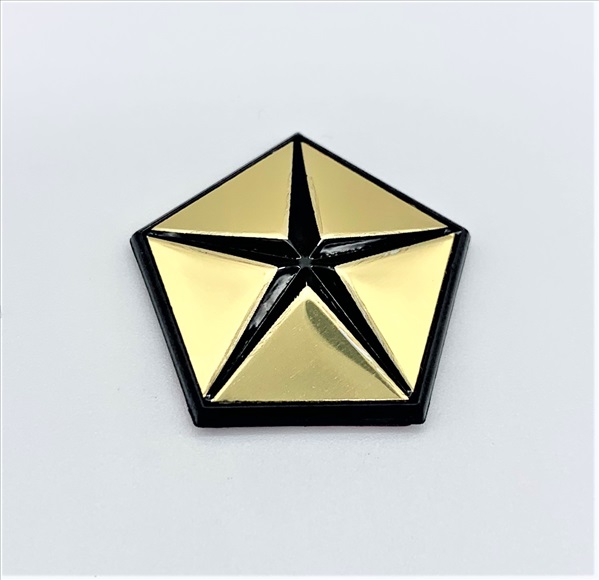
The Pentastar was introduced in 1962 after Chrysler president Lynn Townsend wanted a new corporate symbol. Chrysler hired advertising executive Robert Stanley to develop the design. The resulting emblem consisted of five triangles arranged around a central pentagon, creating a five-pointed star. It was clean, modern, and relatively easy to reproduce, but its most important characteristic was that it did not belong to any one Chrysler automobile division.
The Pentastar was a corporate symbol rather than a vehicle brand. It could appear on a Chrysler, Dodge, Plymouth, or Imperial without suggesting that one division was subordinate to another. The design also worked extremely well in an era when automobile manufacturers were becoming increasingly concerned with corporate identity. Chrysler began placing the Pentastar on its vehicles, literature, advertisements, facilities, and corporate communications. It was not necessarily the most prominent emblem on the automobile, because a Chrysler still carried the Chrysler name, a Dodge remained a Dodge, and Plymouth remained Plymouth. The Pentastar simply tied them all together.
Gradually, the public began to associate the symbol with the entire Chrysler organization.
It Was Not Always a “Mopar” Symbol
This is an important distinction because the Pentastar and Mopar technically represented two different things. The Pentastar represented Chrysler Corporation, while Mopar originated as a brand associated with Chrysler’s replacement parts and service business. The word “Mopar” itself came from “MOtor PARts.”
Over time, however, Mopar became much more than a parts label. It became shorthand for the entire Chrysler performance and enthusiast world. That meant the Pentastar eventually became intertwined with Mopar culture even though the two were technically different. For the enthusiast, the distinction became almost irrelevant. A Pentastar on a parts box, dealership sign, service manual, engine component, or vehicle became part of the visual language of Chrysler products.
The Pentastar and the Muscle-Car Era
The timing of the Pentastar’s introduction was particularly interesting because it arrived just before Chrysler entered one of the most important periods in its performance history. During the 1960s, Chrysler products evolved from family transportation into some of America’s most memorable performance cars. The Chrysler Corporation product line produced vehicles such as the Plymouth Barracuda, Dodge Charger, Plymouth Road Runner, Dodge Super Bee, Dodge Challenger, and Plymouth GTX.
Under their hoods were engines that would become legendary: the 273, 318, 340, 383, 413, 426 Wedge, 426 Hemi, 440, and later the 340 Six Pack and 440 Six Pack combinations. The Pentastar was often present somewhere in the background. It might be stamped into a component, cast into a part, printed on documentation, or displayed at the dealership. It became a quiet reminder that all of these different vehicles came from the same corporation.
A Symbol on Parts
One of the reasons the Pentastar became so familiar to mechanics was its presence on components. A Chrysler technician could encounter the emblem while working on an engine, transmission, electrical component, suspension part, or body component. The symbol became part of the manufacturing language of Chrysler.
For someone restoring a classic Mopar, finding a Pentastar on an original component can therefore be more than a curiosity. It can be evidence of original Chrysler production, particularly on a restoration where originality matters. A small casting mark, stamping, or emblem can sometimes tell a story that a shiny reproduction part cannot. The Pentastar became part of that story.
The Pentastar Goes to Work
The symbol was not restricted to automobiles. It appeared throughout Chrysler’s industrial operation, from dealership signs and corporate buildings to parts packaging, service literature, and advertising. By the 1970s, the Pentastar had become one of the most recognizable corporate symbols in the automobile industry.
It also had an advantage over many automotive logos: it did not depend on a particular vehicle. Model names changed. Division names changed. Body styles changed. Engine families changed. Even entire automobile brands eventually disappeared. The Pentastar remained, and that durability helped turn it into something larger than a corporate logo. It became an emblem of Chrysler history.
The End of the Original Era
Chrysler went through enormous changes during the 1970s and 1980s. The company struggled through financial problems, changing consumer preferences, fuel-economy requirements, and intense competition from Japanese manufacturers. Lee Iacocca became one of the most important figures in Chrysler’s recovery, and the company survived, reorganized, and eventually entered another period of growth.
Through all of those changes, the Pentastar remained associated with Chrysler. But the automobile business continued to change. Chrysler became part of DaimlerChrysler in 1998, later separated from Daimler, and eventually became part of Fiat Chrysler Automobiles and then Stellantis. The corporate identity changed repeatedly, but the Pentastar survived.
The Pentastar Returns to Center Stage
When Fiat Chrysler Automobiles was formed, the Pentastar once again became a major part of the company’s identity. The emblem appeared prominently on modern Chrysler products and corporate material. The design itself also evolved over the years, with different treatments, colors, finishes, and applications, but the basic five-point geometry remained recognizable.
The Pentastar also lives on in a completely different way under the hood. The name “Pentastar” was given to Chrysler’s modern family of V6 engines. Introduced for the 2011 model year, the 3.6-liter Pentastar V6 became one of the company’s most widely used engines.
That created an interesting bit of automotive history. The Pentastar began as a corporate emblem, and decades later Pentastar became the name of an engine family. The logo had effectively become so closely associated with Chrysler that the company could use the name itself as an engine trademark.
More Than a Logo
For many Mopar enthusiasts, the Pentastar represents something more than corporate history. It represents a period when Chrysler products had a distinctive identity. It can bring to mind a 1960s Plymouth sitting outside a Chrysler-Plymouth dealership, a Dodge performance car parked at a drag strip, or a mechanic opening a factory parts box decades ago.
It is also one of those details that can disappear beneath the restoration process. A car can have fresh paint, reproduction decals, new upholstery, and a beautifully rebuilt engine, but the little original Chrysler markings are often what connect the finished automobile to the factory that built it. That is why an original Pentastar casting or stamping can be surprisingly meaningful. It is a small piece of evidence that connects the part in your hand to Chrysler’s manufacturing history.
The Five-Pointed Legacy
Automobile manufacturers have created thousands of logos over the years, and most have been forgotten. The Chrysler Pentastar is different. It survived corporate reorganizations, changing brands, changing ownership, changing technology, and changing automotive tastes. It appeared during the muscle-car era, remained through the malaise years, survived Chrysler’s financial crises, and eventually became the name of one of the company’s most important modern engine families.
The design itself is remarkably simple: five points, five triangles, and one central shape. But that simplicity was its strength. The Pentastar did not try to tell you what kind of car you were looking at. It told you who built it.
For generations of Chrysler enthusiasts, that little five-pointed star became a symbol of something much bigger than a corporation. It became a symbol of Mopar history.
This version keeps the same basic content but gives the story a more continuous magazine rhythm, with fewer one- and two-sentence paragraphs and stronger transitions between sections.


Leave a comment