Published by Christopher J. Holley | Mopar History & Tech | October 2026
Ask ten car people what a muscle car is, and you might get ten different answers.
Some will say it has to be American. Some will say it needs a big-block. Others will insist it must have two doors, rear-wheel drive, a manual transmission, and enough horsepower to make the rear tires question their life choices.
Then somebody will bring up a Mustang. That is usually when the argument begins. But perhaps we are making this much more complicated than it needs to be.
A muscle car was never created by a government agency. There was no SAE standard, engineering specification, or committee that defined exactly what did and did not qualify. The term developed because the automobile industry created something that had not really existed before: relatively ordinary cars with seriously powerful engines. And that distinction matters.
It Started with the Engine
The basic idea behind the muscle car was remarkably simple. Manufacturers took reasonably practical passenger cars and fitted them with large, powerful engines, along with the gearing and performance equipment needed to make that power useful.
The result was a car that could carry passengers, go to work, cruise the highway, and still embarrass considerably more expensive machinery when the throttle was opened. That was the magic.
The muscle car was not necessarily the most sophisticated automobile on the road. It did not need independent rear suspension, four-wheel disc brakes, exotic materials, or European handling characteristics. Its defining feature was straightforward: serious power in a car that ordinary buyers could afford.
The Pontiac GTO is commonly credited with helping establish the formula in the 1960s. Pontiac took an intermediate-sized Tempest and offered it with a 389-cubic-inch V8 and the performance equipment to match.
The formula worked, and other manufacturers quickly understood what was happening. Chevrolet had the Chevelle SS. Plymouth had the Road Runner and GTX. Dodge had the Charger and Super Bee. Oldsmobile had the 442. Buick had the GS. Ford had the Fairlane and Torino.
The names changed, but the basic idea remained the same.
But Was It Really About Horsepower?
Not exactly. This is where the modern definition often goes off the rails. If horsepower alone determined whether something was a muscle car, the definition would be easy: more horsepower would simply mean more muscle. But that is not how the original cars worked.
A muscle car was a combination of power, size, price, and attitude. The car needed enough engine to make it genuinely fast, but it also needed to remain attainable to ordinary buyers.
That is one reason the distinction between a muscle car and a sports car matters. A Corvette could be extraordinarily fast, but it was designed from the beginning as a performance-oriented sports car.
A muscle car was different. It started with something much closer to an ordinary automobile, and then manufacturers gave it far more performance than most buyers actually needed.
That was part of what made the concept so appealing. The car parked next to the family sedan at the supermarket might have a 426 Hemi under the hood, and nobody looking at the closed hood necessarily knew it.
The Sleeper Effect
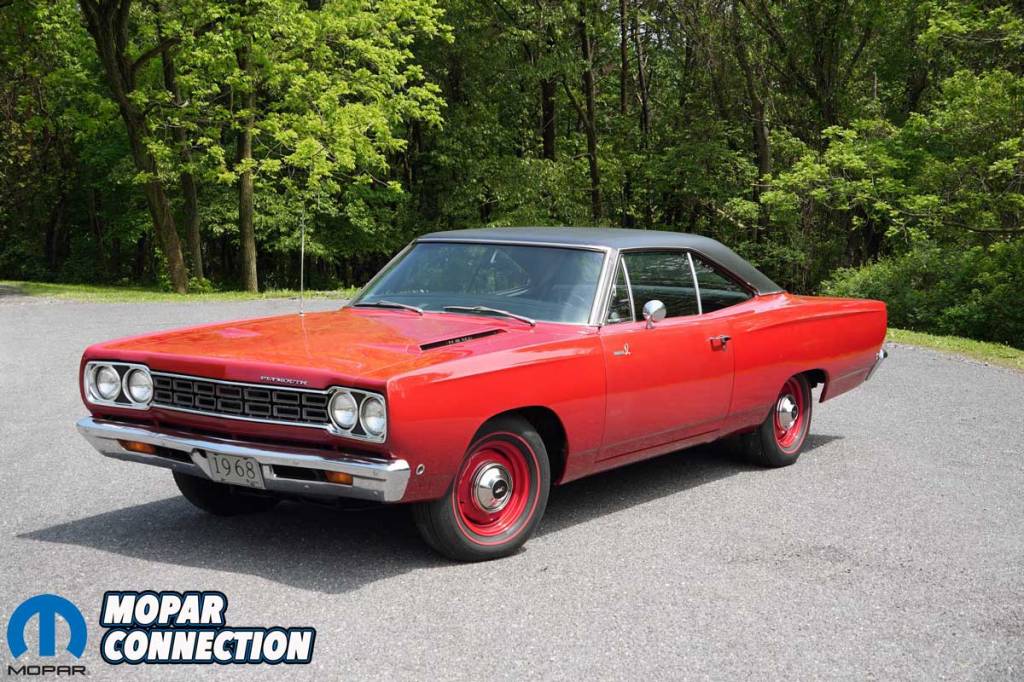
Perhaps nothing captures the muscle-car philosophy better than the sleeper. Consider a Plymouth Road Runner. It was deliberately stripped of unnecessary luxury equipment so customers could spend their money on performance rather than features that did not make the car faster.
The Road Runner was not trying to convince you that it was a luxury automobile. It was built around the idea that going fast was enough.
Other cars took the opposite approach. A nicely equipped Dodge Charger could look almost civilized. With the hood closed, it might resemble another big American coupe. Open the hood, however, and the story changed.
That contrast became an important part of muscle-car culture. The best muscle cars did not necessarily announce their capabilities. Sometimes they looked perfectly ordinary until the driver opened the throttle.
What About the Mustang?
This is where definitions become dangerous.
The Ford Mustang arrived in 1964 ’65 model year) and created an entirely different category: the pony car.
Smaller, lighter, and more compact than the traditional intermediate-sized muscle cars, the Mustang was designed around sporty styling, personalization, and relatively affordable performance. The Camaro and Firebird followed.
Eventually, the distinction between pony cars and muscle cars became increasingly blurred. A Mustang could have a 428 Cobra Jet. A Camaro could have a 396. A Barracuda could have a 440 Hemi.
At that point, trying to place every car into a neat category becomes somewhat pointless. Automobile manufacturers were not interested in preserving our modern definitions. They were interested in selling cars, and if putting a huge engine into a smaller car produced a faster, more exciting automobile, they were going to do it.
Then Something Changed
The muscle-car era did not last forever. Insurance rates increased, emissions regulations became more demanding, and fuel economy became more important. The 1970s brought major changes to the automobile industry.
Compression ratios dropped, horsepower ratings changed, and large-displacement engines disappeared from many showrooms. The classic muscle car, as Americans knew it, effectively disappeared. But the idea did not. It simply went dormant.
Eventually, horsepower returned. Technology improved. Fuel injection replaced carburetors, electronic engine controls became increasingly sophisticated, four-wheel disc brakes became common, and tires became dramatically better.
Manufacturers eventually began producing cars with horsepower numbers that would have seemed almost ridiculous during the original muscle-car era.
Yet something interesting happened. We continued calling some of them muscle cars. Why? Because horsepower was never really the whole story.
So, What Actually Makes a Muscle Car?
Maybe the better question is not, “Does this car meet the definition?” Maybe it is: Does this car capture the idea that created the muscle car in the first place? A muscle car is fundamentally about accessible performance. It takes an automobile that could have been ordinary and gives it extraordinary capability.
The engine and acceleration obviously matter, as does the experience of putting that power to the road. But the car does not have to be exotic to be exciting, and it does not necessarily have to be the most powerful vehicle available.
It does not have to have the biggest engine, a four-speed transmission, or the most sophisticated suspension. The muscle-car idea was never really about perfection. It was about excess: more engine than the car strictly needed, more power than the chassis necessarily required, and more. That was the point.


Leave a comment