Published by Christopher J. Holley | Mopar History & Tech | October 2026
The history of the automotive tachometer is a fascinating story of how a simple industrial measuring device became one of the most iconic gauges in a driver’s dashboard.
The Beginning: Industrial Revolution (1810s)
The first known description of a tachometer was created by British engineer Bryan Donkin in 1810. His device used centrifugal force and liquids to measure rotational speed in machinery. Soon after, German engineer Dietrich Uhlhorn developed what is widely regarded as the first practical tachometer in 1817 to measure the speed of industrial machines. The word tachometer comes from the Greek words tachos (speed) and metron (measure).
The Railroad Era (1840s)
Before automobiles existed, tachometers found a home on steam locomotives. Around 1840, they were used to monitor engine speed, helping operators prevent mechanical damage and improve efficiency.
Arrival of the Automobile (Late 1800s to Early 1900s)
When Karl Benz introduced the first practical gasoline automobile in 1886, tachometers were not yet common equipment. Early drivers relied on engine sound and experience to determine when to shift gears.
As automobiles became more powerful and reliable in the early 20th century, manufacturers began adding engine monitoring instruments to dashboards. Mechanical tachometers driven by gears, cables, and centrifugal mechanisms gradually appeared in performance and luxury vehicles.
The Mechanical Tachometer Age (1920s-1950s)
During this era, tachometers worked similarly to speedometers. A cable connected to the engine rotated a magnet inside the gauge. Magnetic drag moved the needle against a spring, indicating engine RPM.
These gauges became especially important for:
- Racing drivers
- Aircraft pilots
- Truck operators
- Sports car enthusiasts
By the 1950s, many sports cars featured prominent tachometers, sometimes positioned directly in front of the driver because engine speed was considered more important than road speed during spirited driving.
Electronic Revolution (1950s-1980s)
As automotive electrical systems improved, electronic tachometers began replacing mechanical designs.
Instead of using cables, they measured electrical pulses from:
- Ignition systems
- Distributor signals
- Engine control circuits
Electronic tachometers were more accurate, more reliable, and easier to manufacture. By the 1970s and 1980s, tachometers had become a standard feature in many performance cars and manual-transmission vehicles.
The Golden Age of Performance Tachs (1960s-1980s)
This was the period when the tachometer became a cultural icon.
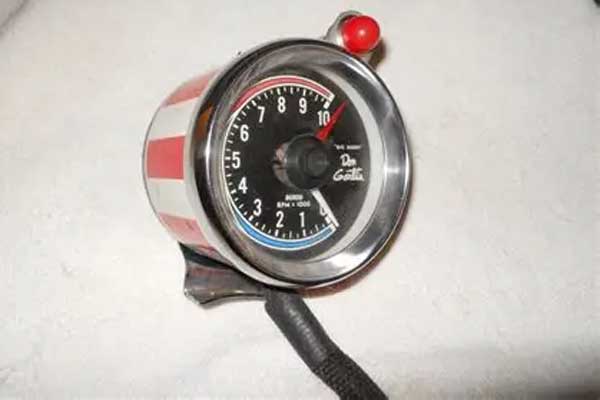
Muscle cars, road racers, and drag racers depended on tachometers for precise shifting. Large aftermarket units from companies such as Vern Westberg’s AutoMeter appeared on dashboards and steering columns across America. Many featured bright shift lights that warned drivers it was time to change gears.
For many enthusiasts, the tachometer symbolized performance. Watching the needle sweep toward redline became part of the driving experience.
Digital Dashboards (1980s-Present)
By the 1980s and 1990s, vehicle computers made engine RPM data readily available. Mechanical movement gave way to electronic stepper motors and digital displays. Modern tachometers can:
- Calculate RPM precisely
- Interface with engine control units
- Record performance data
- Integrate into digital instrument clusters
Some modern vehicles even display tachometer graphics entirely on LCD screens.
Tachometers in the Electric Vehicle Era
Electric vehicles don’t have traditional internal combustion engines, but many still provide power or motor-speed displays inspired by the classic tachometer. Some EVs show motor RPM, while others replace the tachometer with power-consumption and regenerative-braking gauges.
Why the Tachometer Endures
For more than 200 years, the tachometer has evolved from an industrial machine gauge into the heartbeat monitor of the automobile. Even in an age of digital displays and electric propulsion, the concept remains the same:
Measure how fast the monitored component is turning, and tell the operator what the machine is feeling.
To many car enthusiasts, no digital number is quite as satisfying as watching a red needle sweep smoothly toward the redline.


Leave a Reply